About ConfigBranch Atlas
An independent engineering repository dedicated to systematic configuration management, assembly branch logic, and parametric modeling integrity.
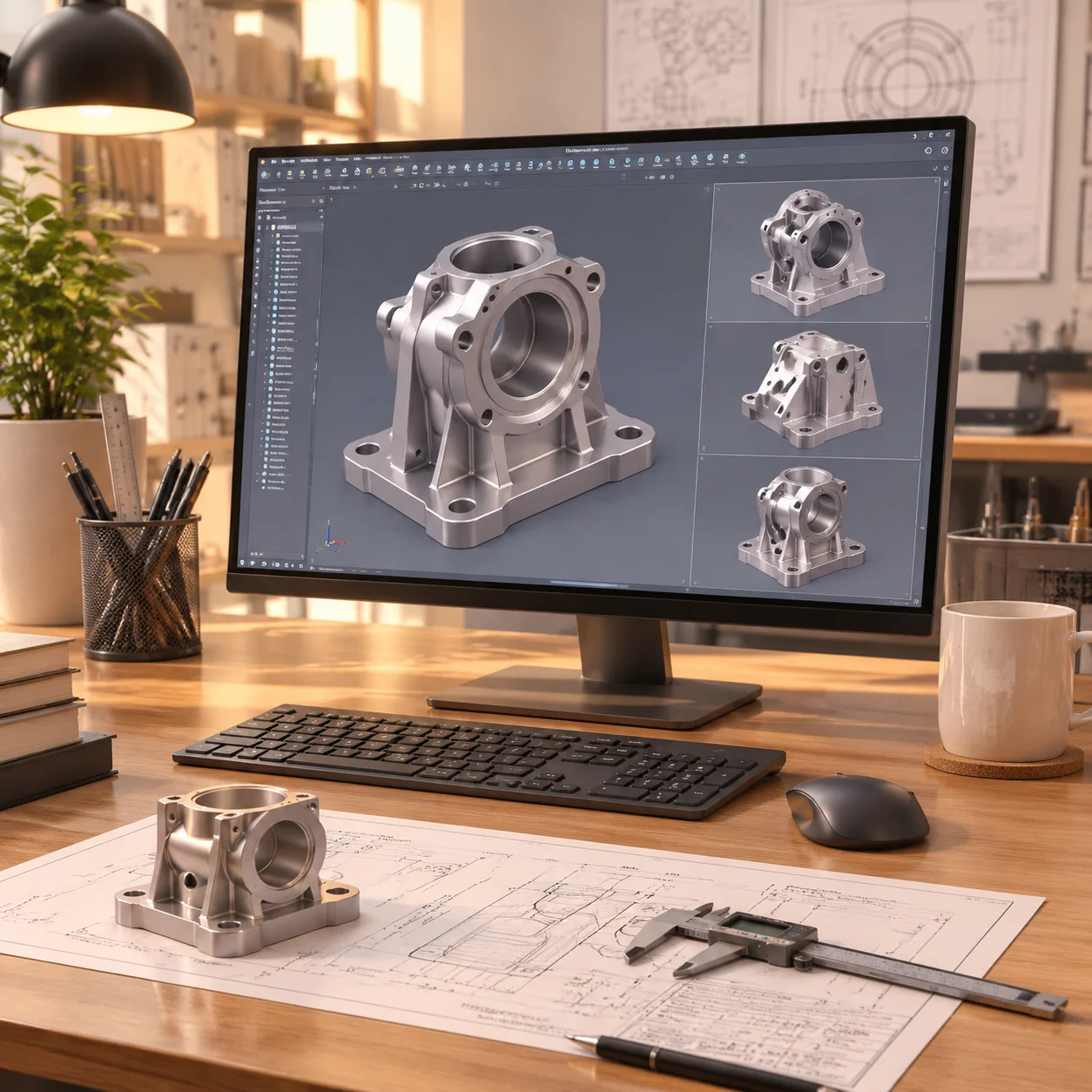
Engineering Logic and Editorial Standards for CAD Variants
ConfigBranch Atlas exists to clarify mechanical modeling architectures. Our publications document how parametric configurations, suppressed features, and branch dependencies behave under production constraints across modern CAD environments.
Deterministic Configuration Verification
Engineering assemblies often degrade into unmanageable file hierarchies when feature trees rely on unconstrained configurations. Every case study and configuration architecture published in ConfigBranch Atlas undergoes verification inside real modeling environments before inclusion in our index.
We evaluate configuration tables against rebuild performance, reference stability, mates durability, and downstream drawing propagation. If a branching technique introduces circular external references or invalid topological rebuilds, it is classified as high-risk and cataloged with documented alternatives.
"A configuration is not simply an aesthetic model variation. It represents a strict engineering branch governed by unambiguous geometric logic and reproducible BOM propagation."
— ConfigBranch Atlas Editorial Board
Our Four-Stage Technical Evaluation Protocol
Root Tree Auditing
Examination of parent-child relationships, reference plane anchors, and base sketches to eliminate uncontrolled dependencies before branching occurs.
Table Consistency
Cross-auditing design tables, equation syntaxes, and linked parameters to confirm that unit systems and dimensional parameters never yield unsolvable geometry.
Rebuild Benchmarking
Quantitative measurement of regeneration durations across multi-body parts and large assembly instances to measure computational efficiency.
Downstream Integrity
Testing bill-of-materials generation, component isolation, and drafting view links to ensure configuration changes do not orphan annotations.
Independent Engineering Contributions
ConfigBranch Atlas operates without proprietary manufacturer sponsorships or vendor bias. We assess native configuration mechanics, family tables, and multi-configuration assembly trees purely through the lens of engineering accuracy, documentation clarity, and computational stability.
Mechanical design teams, CAD administrators, and mechanical researchers are welcome to submit technical inquiries, edge-case configuration models, or correction requests directly to our editorial team.